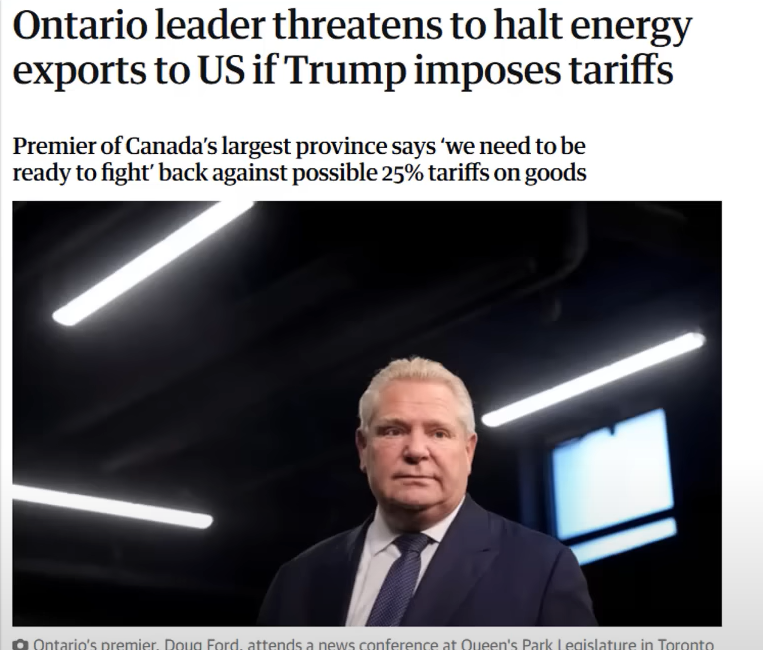


A World in Transition: The Geopolitical Shift of the USA and the Battle for the New World Order
A World in Motion, a Superpower at a Crossroads
The global balance of power is undergoing a historic transformation, and at the center of it stands the United States. Once the uncontested architect of the post–Cold War world, Washington is now navigating a far more complex and fragmented international landscape. From rising multipolar competition to economic nationalism, from proxy conflicts to technological rivalries, USA geopolitics is evolving faster than at any point since the fall of the Soviet Union.
As we move deeper into geopolitical shift 2026, the United States is no longer just projecting power — it is recalibrating it. The choices America makes today will define the new world order for decades to come.
From Unipolar to Multipolar: The End of Absolute Dominance
For nearly three decades after 1991, the United States operated in a largely unipolar system. Military superiority, economic influence, cultural soft power, and control over global institutions gave Washington unmatched leverage.
That era is fading.
Today’s global system is increasingly multipolar, shaped by:
- China’s economic and technological rise
- Russia’s militarized foreign policy
- The Global South demanding strategic autonomy
- Regional powers asserting independent influence
The geopolitical shift 2026 reflects a reality where the U.S. must compete, negotiate, and sometimes retreat — rather than dictate outcomes.
USA Geopolitics and the Strategic Pivot Away from Global Policing
One of the most visible shifts in USA geopolitics is the gradual move away from being the world’s primary military enforcer.
Recent trends highlight this transition:
- Reduced appetite for large-scale ground wars
- Greater reliance on alliances rather than unilateral action
- Emphasis on deterrence over direct intervention
The chaotic withdrawal from Afghanistan symbolized this change. It wasn’t just a military exit — it was a geopolitical signal that the U.S. is redefining its global role.
America is no longer trying to be everywhere at once.

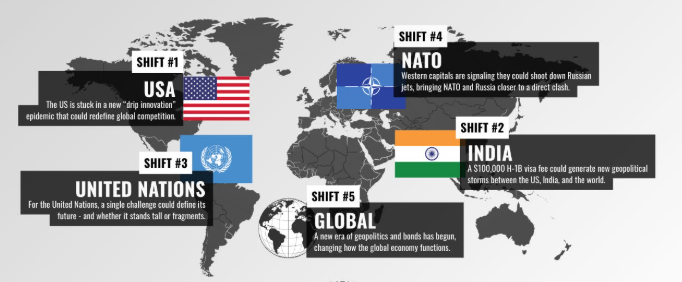
Ukraine, Taiwan, and the Rise of Proxy Power Struggles
Rather than direct confrontation, the United States is increasingly engaged in proxy-based geopolitics.
Ukraine War: A European Power Test
The U.S. has poured billions into supporting Ukraine without deploying combat troops. This strategy reflects a broader doctrine:
- Contain adversaries
- Preserve alliances
- Avoid direct war with nuclear powers
Taiwan: The Indo-Pacific Pressure Point
In Asia, U.S. support for Taiwan represents the most dangerous fault line in the geopolitical shift 2026. Washington is walking a tightrope — deterring China while avoiding escalation that could destabilize the global economy.
These flashpoints show how the new world order is defined by indirect confrontation rather than outright war.
Economic Warfare: Sanctions, Supply Chains, and Strategic Decoupling
Modern geopolitics is no longer driven solely by tanks and missiles. Economic tools have become weapons.
The U.S. has aggressively used:
- Sanctions on Russia, Iran, and China-linked firms
- Export controls on semiconductors and AI technology
- Pressure on allies to “de-risk” from China
This marks a major evolution in USA geopolitics — from free-market globalization to strategic economic nationalism.
America now views supply chains as matters of national security, not just efficiency.
Technology as the New Battleground of Power
No aspect of the geopolitical shift 2026 is more critical than technology.
The U.S. is racing to maintain dominance in:
- Artificial intelligence
- Quantum computing
- Semiconductors
- Space and satellite systems
- Cyber warfare
Unlike the Cold War’s arms race, this is a digital cold war, where innovation determines influence.
Whoever controls technology standards will shape the new world order.
The Changing Nature of Alliances: NATO, QUAD, and AUKUS
America’s alliances are evolving from static defense pacts into dynamic power networks.
NATO’s Reinvention
Once declared “obsolete,” NATO is now more relevant than ever, expanded and militarized by the Ukraine conflict.
Indo-Pacific Coalitions
Groups like QUAD (U.S., India, Japan, Australia) and AUKUS represent America’s long-term strategy to counterbalance China without formal war.
USA geopolitics now relies on coalition leadership, not lone superpower status.
The Global South Pushback: A Multipolar Reality
One of the most underestimated elements of the geopolitical shift 2026 is resistance from the Global South.
Countries in Africa, Latin America, and Asia increasingly:
- Refuse to align fully with the U.S. or China
- Demand economic fairness rather than ideological loyalty
- Prioritize development over geopolitical rivalry
This challenges Washington’s traditional diplomatic playbook and forces a rethink of influence strategies.
Domestic Politics and Foreign Policy: America’s Internal Struggle
USA geopolitics cannot be separated from domestic realities.
Internal polarization, economic inequality, and election cycles increasingly shape foreign policy decisions. Allies now factor U.S. political volatility into long-term planning.
This internal fragility is a defining feature of the new world order — where power is not just external, but deeply domestic.
Is the United States Declining — or Transforming?
A critical question dominates global debate: Is America losing power?
The answer is more nuanced.
The U.S. remains:
- The world’s largest military spender
- A leader in innovation and finance
- A cultural and institutional powerhouse
However, it is transitioning from hegemonic dominance to strategic influence.
This is not collapse — it is transformation.
The New World Order: What Comes Next?
As geopolitical shift 2026 accelerates, several defining traits of the new world order are emerging:
- No single global ruler
- Regional power centers
- Technology-driven influence
- Economic security over free trade
- Permanent competition without permanent war
The United States will still be central — but not supreme.
Conclusion: America’s Defining Moment in Global History
The geopolitical shift of the USA is not about retreat or surrender. It is about adaptation in a world that no longer revolves around one capital.
In 2026 and beyond, USA geopolitics will be judged not by how much power America holds, but by how intelligently it uses it. The era of absolute dominance is over — but the era of strategic leadership is just beginning.
The choices Washington makes today will not only determine America’s future, but will define the new world order itself.